NEW:
QUICK TOUR
PAINTINGS & DRAWINGS
(MULTI-YEAR )
| HOME |
|
PHOTO |
|
RESUME | TOUR & STATEMENT | PUBLICATIONS & CONTACT |
Artist Blog |
|
|
|
NEW: QUICK TOUR |
TOUR &
ARTIST STATEMENT:
SEEKING QUESTIONS TO LIFE'S
BIG ANSWERS (or, Make Beauty Work)
|
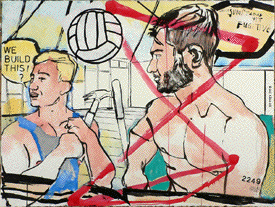
ON THE ARTWORK... For years my work has encompassed painting and photography, with occasional works in sculpture, writing, and other media mixed in for variety. When I worked with landscape imagery and the constructed environment in painting years ago I liked to talk about formal concerns: painting as map or diary or arena linking visual and verbal, conceptual and material, fact and fiction, abstraction and representation; not to mention a blend of styles and a viewer building bridges between disparate ideas and iconographies. While all this remains true, with the paintings today I would say that, given how many images we are all bombarded with every day via the media, I am simply interested in making memorable ones. The figure has taken center stage since 2003, and my goal with the young men who dominate the images and constitute my muse is to present them as everyman, reaching beyond the fleeting surface idealization associated with youth and hopefully going far in terms of metaphor, poking around such timeless ideas as: truth, beauty, faith, time, the infinite, what we learn and what we know. It may seem questionable indeed these days to even concern myself with such unanswerables, but in an era when political and spiritual leaders assert that they in fact have the answers for us all, I think that art has the capacity to imagine otherwise, to offer some transcendent spark to bridge the gap between intent and form, between idea and the evidence of our lives. Muse indeed. The current paintings and drawings sometimes put aside seamless spaces in favor of multiple and disjunctive ones. At the same time there is a continued interest in mapmaking and the idea of the document. Since 2002 I have been numbering the pieces sequentially and sometimes stamp them with the dates I worked on them -- perhaps in an attempt to keep track of time, but also, perhaps, to consider that experience is cumulative and overlapping, embellished over the course of days and enriched by simultaneous, if discordant, ideas. Sometimes when I take a very long time to resolve a particular work I give it two numbers -- where it was in the queue when I first began, and where it was when I finished, thereby implying that the intervening works can have informed it in some way. This is especially true when I go back and rework something that I had "finished" years earlier. For me the work is always fair game for reappraisal -- something that seems to happen in everyday life as well. The works are annotated with words or images that, when compiled into a book or exhibition or globe, suggest reading from left to right, right to left, upside-down or inside-out. My goal is to make images that are memorable not only via their stylistic variety, in a sense creating flags that signal a kind of symbolic territory, but also to offer you a kind of map where it is your responsibility to build bridges across the middleground between images and ideas. The beauty, hopefully, of interpreting such a construct, then, is that while I might think I may have layed out a map in front of you, I cannot guess where you might choose to go, or even which route you might take. |
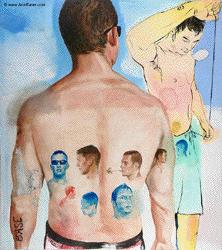  |
AND, ABOUT ALL THESE GUYS... Recently, a gallerist in New York expressed her difficulty in thinking about or talking about my work beyond its population of many young men who happen to be rather attractive. "I mean, beautiful boys on the beach, OK, but beyond that...," she said, her voice trailing off into an open question. I couldn't wholly disagree, because who hasn't been disarmed by beauty? Some years ago I was having a sliver of glass removed from a fingertip by a hand surgeon who happened to be one of the most beautiful women I'd ever seen in my life, and I left her clinic knowing that not a few guys in my shoes would immediately go out to the parking lot and slam their fingers in their car doors just so they could go back in and set up another raft of appointments with her. Beauty can do that to you . But process that with another task or function? It could be asking a lot. And yet, it can be done, even when we don't suspect. Even more years ago, during one of my university visiting artist gigs, one of my students expressed his desire that his art have a political dimension. I responded by asking him to empty his pockets. Out came a screwdriver, which I held up to him and asked him to look at more closely. Here was a symbol of labor and also a tool, conjuring up not only various class structures and "work" (and attendant political organizations across the globe) but also, these days, the digital-analog divide. Here was a marriage of plastic and steel, testimony not only to science and physics, but also touching on depleting world resources (the plastic handle versus the older-fashioned wooden ones), not to mention, because it was labeled "Made in China," a world economy, a shift of manufacturing jobs, and on and on. Plus, this red and yellow plastic and steel thing could also be discussed as good-design / bad-design (i.e. in form follows function), as well as a "pure" aesthetic object.. My point, of course, was scratch below the surface and no telling what you'll find. So the guys in the paintings? Well, I am scratching them below the surface and putting them to work. And they are no strangers to it (the work, that is) given the many gyms I find them in. Often for the sake of sports, but just as often for the sake of picking up girls, they work out knowing the power of beauty. But I see them too as eminently malleable, waiting for instructions, stem cells in a way and eager to please. They are everyman and my muse, off and doing guy things in the paintings, political things, religious things, introspective things and full of stories and philosophy, and all the while not caring that the world, let alone the art world, views them as suspect because of their beauty (in the same way that beautiful paintings, or even all paintings, are often viewed as suspect these days in some precincts of the art world.) I put them out there too to counter the prejudice many in the world have felt for centuries in favor of female beauty, still ubiquitous on all fronts in our daily lives. Almost always metaphoric in nature, I hope the images here are a far cry from those found in run-of-the-mill coffee-table books of hot guys lying oiled and naked among tattered factories and skeins of rope. As fun as that might be, I want my guys instead to go beyond objects of desire, to straddle the brawn vs. brains divide and do some mental lifting at the same time that they muscle up. But I put them out there as a fait accompli, denizens of a world who take everyone's gaze in stride, male or female, straight or otherwise, going about their business as testimony of a world that has changed and whose change, by being themselves, they have helped to bring about. Ultimately, thus, the work is political. It addresses that big question of what kind of world do you want to live in? I prefer one where we can all live up to our potential. And if there's work to be done, we, and hopefully these guys, are up to the job. Better yet, since I do think of them as everyman, they are, simultaneously, already part of us. |
THE BACK AND FORTH OF PAINTING, PHOTO, WRITING
AND SERENDIPITY
I first began to paint landscape
while in high school, but in college wound up studying sculpture
for both my undergraduate and graduate degrees. During those college
years I discovered photography not only as a break from "the
usual," but also as a way to remain an artist during those
summers when I indulged my love of travel. When I moved to Los
Angeles after graduation, however, I returned to painting as an
inexpensive and highly portable medium for someone trying to live
on the cheap in a Pasadena studio. My subject matter quickly returned
to landscape after about a year there, as I landed a job as a
solo cross-country truck driver for an art-shipping company and
proceeded to spend weeks upon weeks driving and looking at nothing
but the landscape. But while driving, the time and energy constraints
of the job did not allow me to paint at night in motels, so I
turned to photography again during the day -- pulling over for
a minute or two to take some photos, and I started to write as
well in restaurants or out walking at night, at first descriptions
about the places I was driving through. Gradually I began to throw
in bits of fiction and eventually layered these texts onto the
paintings, offering verbal tangents to go off on but which emanate
intuitively from the images.
 1990's Painting Archive |
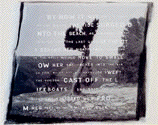
 The Plains of San Augustin, New Mexico, 1986 |
When I began in the mid-80's to fly around the country as part of the job, the flying intensified my interest in the landscape since I could now gaze out the window and within a few hours watch landscape go by that it had taken me days to drive, and compare it to the road atlas opened on my lap. Landscape as document, landscape as territory, landscape as diary. By the time the job ended I had begun to compile a manuscript about it called MILEMARKER; based on its strength I wound up teaching writing at the University of Colorado in Boulder-- at first freshman composition, and later art writing. During this time (the mid-1990's) the paintings had grown to nearly seven-foot-square iconic presentations of symbols (flags, planes, furniture, animals) on canvases that fold or roll up like maps, sometimes having been sewn together like flags from smaller pieces of canvas. For a 2-year period around 2000, I devoted more time to exploring abstraction, appropriation and techniques in works structured again like maps. But in 2002 I returned to painting imagery based on day-to-day experience and travel photography, starting to include stories once more and other information, much like the annotation to be found on the backs of photographs or at the edges of an atlas.
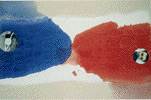 |
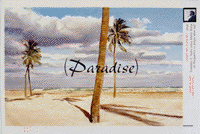 |
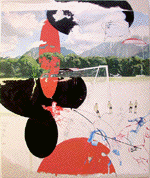 PAINTINGS 2003-2004 |
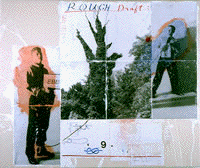 |
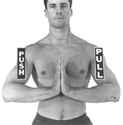
Layered over all of this since 1995 was a new series of photographs called STUD DUST . Started on an intuitive whim, these single-frame B&W images deploy men in my studio to interact with signs, tools and other props. They are stand-alone images and are on-going, but when I began in 2001 to paste them onto canvas and draw and paint on them, the new Photo Canvases were more like maps than anything else to date. At times the photos seem to touch on ideas of self-image in an age of media saturation, as well as on age, ephemerality, territory and perception. But as I gradually started to include myself in many of the images, I realized too that they are just as much about my own ageing vis a vis a veneer of perfection and beauty, about my own transition from a world I used to think of as accessible to one in which other conjurings both physical and mental take place. These figurative concerns have entered the latest paintings now, brought about in part by osmosis, and heightened by a year's worth of teaching painting and figure drawing as a visiting artist at the University of Arizona in Tucson, in 2003-04.
NOTES ON THE OTHER MEDIA
I do delve into other media from time to time, but more when opportunities present themselves these days, rather than out of habit as in the past. A sample:
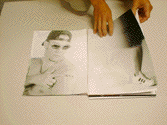
My interest in history as content began with three public art proposals for the City of Dallas in 1994, 95 and 98 for which I was asked to write poems based on neighborhood histories. Then, in 1996 while a visiting artist at Florida State University, I did a series of paintings of Spanish Moss hanging from the trees called "SPANISH MOSS: AN EFFIGY OF THE SOUTH," which were paired with photos of hands holding books open to historic images of lynching victims. While the paintings could have been considered a tourist's response to north Florida, the photographs became a way to delve into the racism of the Chicago neighborhood in which I grew up.
History on a more personal level then found its way into some of my infrequent sculptures. A 1999 piece THE OBERDICK CHAISE, incorporates a silkscreened story in which I muse about the history of the house I live in and the people who owned it before me, while the materials themselves speak of history too, since they are clapboards saved from a kitchen remodeling project. Other works revolve around the idea of the house too, from furniture-like chairs made of drywall scraps or fenceposts adorned with the names of American Indian tribes, to an installation called MY MOUNT RUSHMORE in which a long text about leaving my own history somewhere in the house, for whomever owns it next, is written on the walls of a bedroom I was remodeling, the day my drywall contractor was supposed to show up and start covering everything with new sheetrock.
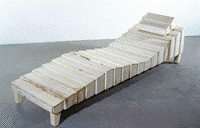 OBERDICK CHAISE |
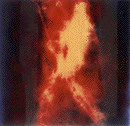 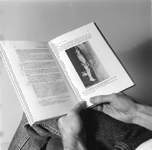 EFFIGY Claude Neal Lynched |
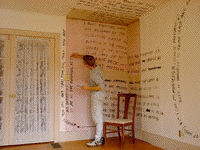 My Mount Rushmore |
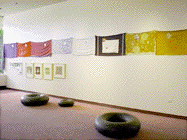 Bathers: An Installation Bathers: An Installation |
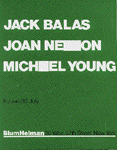 Name Matters |
 |
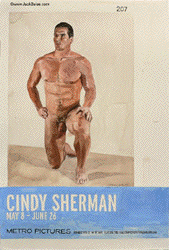 MUSE / MUSEUM |
Another example, "NAME MATTERS," is a conceptually-based series of works on paper that considers the segmentation or specialization to be found in today's art world. The series takes ads from art magazines and, via collage or other media, inserts my own name into lists or other monolithic presentations of "big" names -- at once offering fictions that could become reality upon reproduction or publication, while questioning the surface styles that go along with name recognition. The subsequent series "ACTS OF APOSTLE" is more fanciful, taking the pages of an old Janson's art history text and musing (with a variety of media) about what and how we learn in all those darkened slide-projection classrooms.
DETOURS
Over the years, I've spent a considerable amount of time detouring
the guys into various subsets of work. The longest running has
been MUSE / MUSEUM, a series
of watercolors and photos replicating art magazine advertising
or editorial layouts in which I substitute my own imagery for
that of the advertised or editorialized artist. As an artist looking
at the magazines every month and visiting galleries and museums
across the country, it's natural, I think, to imagine my own work
on the pages and in the spaces. These paintings take the visualization
process a step or two further, engaging issues of persona and
autonomy at the same time. In this way I get to pay back, in a
sense, a number of the artists whose work I have been carrying
around in my head practically my whole life. At the same time
I get to toy with the notion of how acceptable it has been for
the world and art world to consume images of women without barely
a thought, it has been so de rigeur. In this series I wanted to
see images of men for men's sake, for my sake.
Another detour has been literally that. TATTOO DETOUR is comprised of pen and ink drawings I've managed to make while on summer vacations in Honolulu. With so many shirtless and inspiring young men all over Waikiki, I found the perfect way to make art out of a suitcase was to walk the beach photographing various people, and then draw from the photos. With so many tattoos on very prominent display, however, I've been playing with the idea of palimpsest in the drawings and subsequent paintings as well. It really goes back to self-portraiture and the STUD DUST series. You've got all these guys willing to put on their shoulders, and abs, and pecs, and legs and wherever, images and symbols and ideas that have something to do with who they really are deep down, whether it's something they picked out of a tattoo shop design folder or something they drew up themselves. They know, and we all know, the power of an image. And in a way they're trying to draw strength from an image; perhaps because tattoos are so long lasting. Barring laser removal these days, they're something you'll carry to your grave.
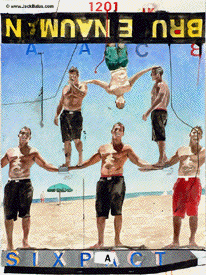 MUSE / MUSEUM ALL YEARS |
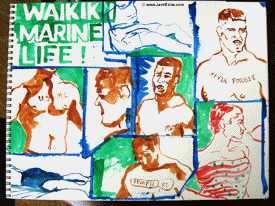 TATTOO DETOUR 7 Drawings from Honolulu 2013 |
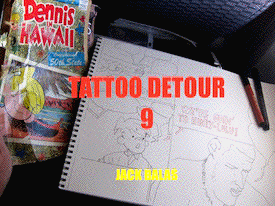 DENNIS THE MENACE GOES TO HONOLULU 2015 |
There is a new world of openness (or at least awareness) many men feel to being depicted (and consumed) as image or idea. They are complicit in our looking at them, because they know that deep down the images are timeless, at the same time that they deny, or at least forestall, that giant clock ticking, ticking, ticking. Awhile back a guy was in the gym with a tattoo under his arm saying 'Memento Mori.' I asked him, 'Dude, does that work for you? He grinned at me wolfishly, saying 'Every time, baby. Every time.'"
Where does all of this leave the viewer, then, amid the ebb and flow (mostly flow) of images inundating us from all precincts of the globe on a daily, hourly, minute-ly basis? Hopefully with images that are memorable. Admittedly, the talk of maps and documents can only go so far, perhaps to help locate the work within a broad swath of the artworld shared by (but not limited to) H.C. Westermann, Philip Guston, Andrew Wyeth, Joan Brown, Willem de Kooning, Neo Rauch, Norbert Bisky, Raymond Pettibon, Duane Michals and Enrique Chagoya. In a sense this laundry list of soul-mates describes one of my favorite past-times, surfing art magazines and taking in not only the articles but the ads, the graphic design, and the unpredictable juxtapositions one encounters from one page to the next. But beyond all of this a poet too works out, constructing each painting patiently as if in the gym, knowing that each repetition or set builds on the last, and that the images get stronger, at the same time that they broaden into unknown territories.
Artists have a responsibility
to put out, to put the skill up on the wall, to put the ideas
out there, to use it all, as much as you've got. The gym dudes
I paint bust their butts to change themselves, to get more powerful
all the time. I have my doubts about art being able to change
the world, but I do know that art has changed my world, and that
these guys have changed my life. And that's pretty damn powerful
if you ask me.
Jack Balas